
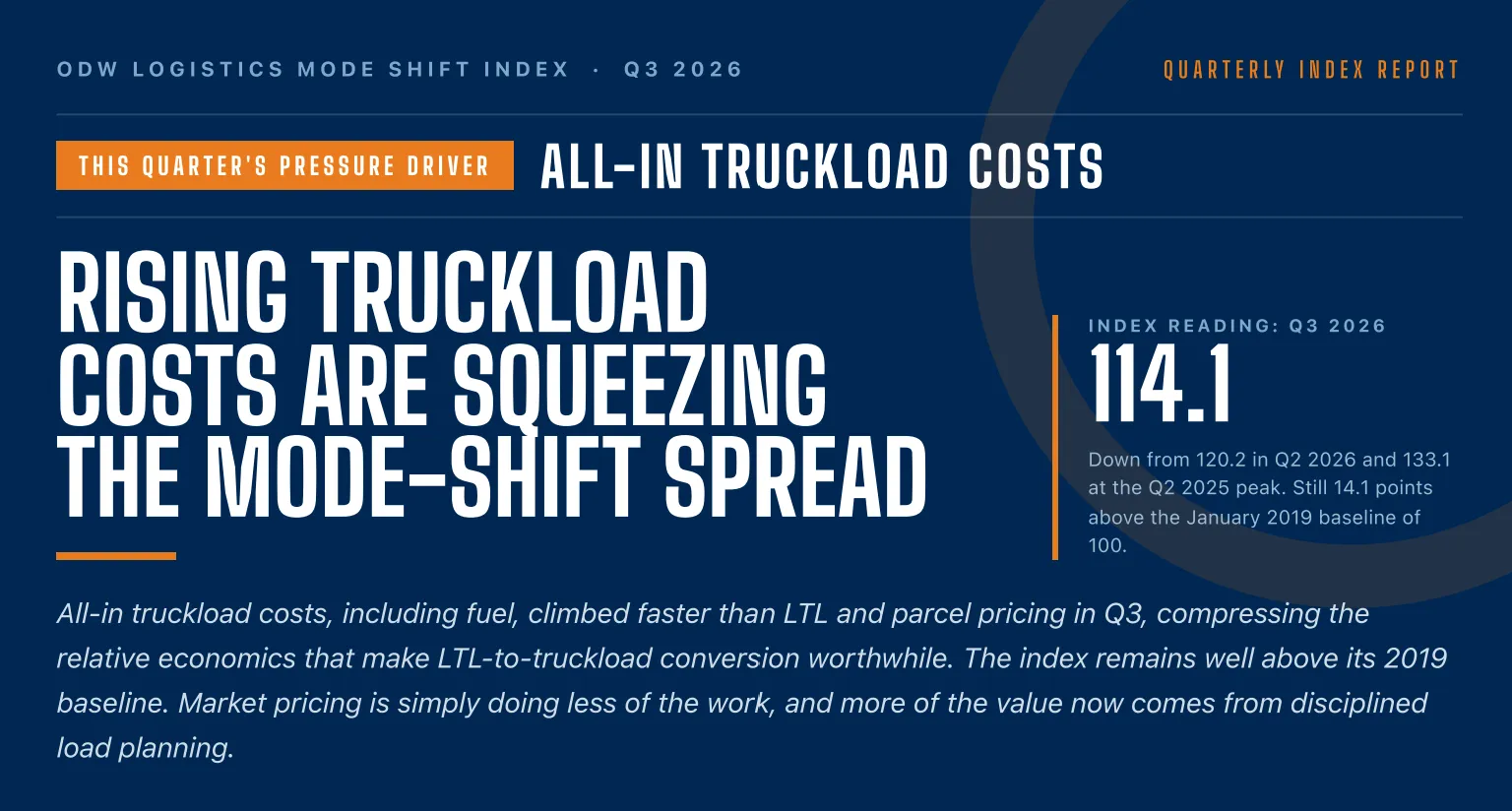
Cost gap between shipping modes narrows as the ODW Mode Shift Index falls to 114.1 in the third quarter from a 2025 peak of 133.1, making freight consolidation harder to capture and more important to secure
COLUMBUS, Ohio, Nov. 11, 2026 (GLOBE NEWSWIRE) -- ODW Logistics today released the ODW Mode Shift Index for the third quarter of 2026. The quarterly index measures whether the relative economic conditions supporting mode shifts are expanding or contracting compared with January 2019. It tracks the cost relationships among truckload, less-than-truckload (LTL), and parcel shipments that make converting LTL freight to truckload or parcel shipments to LTL cost-effective. This quarter, the index read 114.1, 14.1 points above its January 2019 baseline of 100, as all-in truckload costs, including fuel, climbed faster than LTL and parcel pricing.
When the index falls, as it has for five straight quarters, the opportunity remains, but it depends more on execution. The index rose above 100 in the second quarter of 2023 and peaked at 133.1 in the second quarter of 2025. It has since fallen to 120.2 in the second quarter of 2026 and to 114.1 in the third quarter.
“Rising truckload rates have made freight consolidation more complex, but the opportunity for customer savings remains,” said Dave Giblin, executive vice president of transportation management at ODW Logistics. “Delivering those savings often requires more sophisticated load planning, greater shipment density, additional stop optimization, and closer coordination around delivery requirements. As market conditions evolve, ODW continuously adjusts network designs and transportation strategies to help customers capture the greatest possible value from every shipment.”
The third-quarter reading covers July through September, when the index’s blended truckload rate, measured all-in including fuel, averaged about $3.05 per mile, up roughly 6% from the second quarter. ODW builds consolidated loads for shippers across North America, so it sees mode-shift economics change in its own network before those shifts appear in a freight budget. Independent data is consistent with what ODW is seeing: the Cass Truckload Linehaul Index read 154.8 in September, up 10.1% year over year.
That matters because, according to the index, the relative economics are likely to stay below the 2025 peak as long as all-in truckload costs hold near current levels. Freight volumes, by contrast, are stabilizing rather than surging, with Cass shipments up 1.9% year over year in September. The American Trucking Associations reports capacity is still contracting, and other recent data agrees. FreightWaves SONAR shows for-hire tractor counts fell by roughly 51,000 in August, and ACT Research reports capacity tightening earlier than usual ahead of the holiday season. LTL pricing, meanwhile, increased through the quarter but averaged slightly below the second quarter, and parcel pricing was essentially flat. When truckload costs rise faster than LTL, the LTL-to-truckload spread narrows and the index falls, regardless of how well a shipper or its logistics provider executes.
A lower index does not mean mode shift has stopped making economic sense. The relative economics are still more favorable than in 2019, but market pricing is doing less of the work than in 2025. Freight spend is also climbing fast, with Cass freight expenditures up 20.4% year over year in September. That means shippers face a bigger cost increase, and mode optimization remains one of the most effective tools for offsetting it.
“If you’re not actively optimizing your transportation network, you’re leaving one of your most effective cost-management levers on the table,” Giblin said. “While the opportunity may be smaller than it was a year ago, rising transportation costs make optimization more important now. Operational improvements can often deliver greater long-term value than rate negotiations alone.”
The index recommends three steps for shippers this quarter:
- Establish your baseline. Price each mode and lane at current market rates, not last year’s.
- Plan for the coming quarter. Today’s cost spreads may look very different next quarter.
- Start simple. Look for purchase order and origin-destination pair matching before opening new lanes.
Furthermore, the index blends two components. LTL-to-truckload, weighted 75%, compares DAT spot and contract truckload rates with the U.S. Bureau of Labor Statistics Producer Price Index for LTL. At 119.3, it drove the entire third-quarter decline but remains well above its 2019 level. Shippers moving palletized freight into big-box distribution centers should track this side and expect more multi-stop builds and pool distribution to achieve the same result.
Parcel-to-LTL, weighted 25%, compares the BLS Standard Courier Services and LTL price indexes. At 98.7, it sits slightly below its 2019 level because LTL prices have risen a little faster than parcel prices over that period. For parcel-heavy shippers, consolidating small shipments into LTL can still pay, but the case rests on density and planning.
One component sits above its 2019 level and the other slightly below, so the full report shows how the index applies to palletized, parcel-heavy and mixed networks. For more information, visit odwlogistics.com.
ABOUT ODW LOGISTICS
ODW Logistics is a 3PL provider specializing in integrated logistics solutions. We help companies make smarter choices about warehousing, e-commerce fulfillment, and transportation decisions so they can streamline costs and operate more efficiently. We take a strategic approach to logistics planning and find solutions to control costs and get your product to your customers as efficiently as possible. Our commitment to partnership and combination of technology, team, and process allows us to deliver on our promises. Gain visibility into your supply chain and realize the operational efficiencies that will help your company grow. See how we Deliver the Difference and help you reimagine your supply chain. www.odwlogistics.com
Media Contact
Amber Good
LeadCoverage
amber@leadcoverage.com
A photo accompanying this announcement is available at https://www.globenewswire.com/NewsRoom/AttachmentNg/a6b4feb5-8df9-4438-aeef-2d0f4d42af0b








Comments (0)
Login to join the conversation
Login / RegisterNo comments yet. Be the first to comment!